

Dua e Qunoot: Meaning, Timing, Witr Prayer & Sunnah References
A clear parent-friendly guide to Dua e Qunoot: what it means, when it is recited, how different schools understand it, and how children can learn it with confidence.
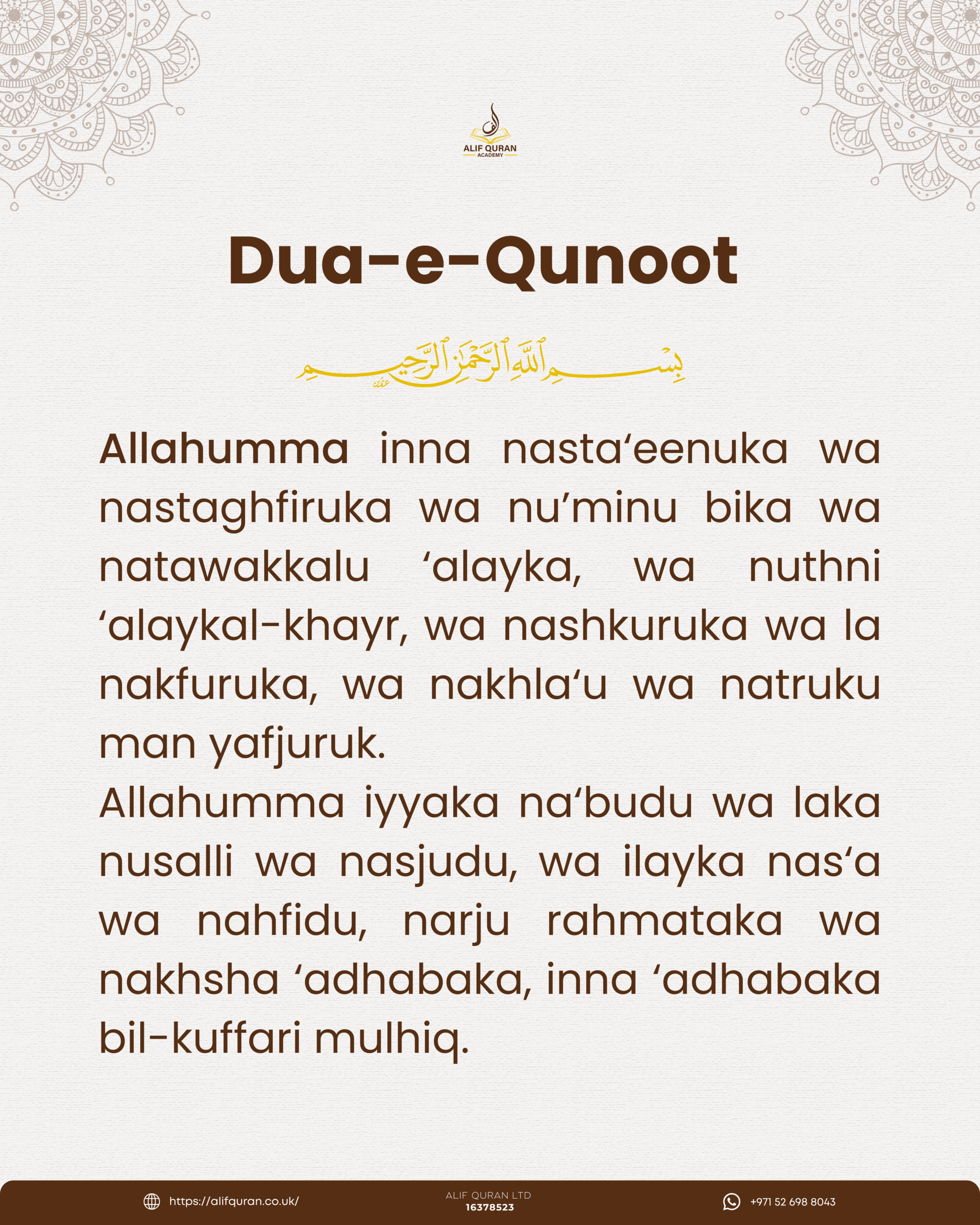
Dua e Qunoot Arabic, Transliteration and Meaning
Use this clear image for reading, revision and memorisation practice before moving into the full explanation below.
What Is Dua e Qunoot?
Dua e Qunoot is a special supplication recited while standing in Salah. The word Qunoot carries meanings of obedience, humility, devotion and standing before Allah with sincerity.
Many Muslims learn it during their Witr prayer, and parents often ask how to teach it to children because it is longer than many daily duas. At Alif Quran Academy, we teach it gently with meaning, repetition and small memorisation steps.
اللّٰهُمَّ إِنَّا نَسْتَعِينُكَ وَنَسْتَغْفِرُكَ وَنُؤْمِنُ بِكَ وَنَتَوَكَّلُ عَلَيْكَ
Allahumma inna nasta'eenuka wa nastaghfiruka wa nu'minu bika wa natawakkalu 'alayka...
O Allah, we seek Your help, ask Your forgiveness, believe in You, and rely upon You.
When Do We Read Dua e Qunoot?
The timing of Qunoot may differ depending on the school of Islamic jurisprudence a family follows. This is why some Muslims recite it in Witr, while others may recite Qunoot in Fajr or during difficult times.
During Witr Prayer
In the Hanafi school, Dua e Qunoot is commonly recited in the third rak'ah of Witr before going into ruku.
During Fajr or Hardship
Other schools mention Qunoot in Fajr, and Qunoot e Nazilah may be recited during times of hardship for the Muslim community.
Is Dua e Qunoot Fard, Wajib or Sunnah?
Families may hear different answers because scholars classify Qunoot differently across schools of thought. A respectful summary is:
- Not Fard: It is not one of the core pillars of Salah.
- Wajib in the Hanafi school: For Hanafi followers, reciting Qunoot in Witr is necessary.
- Sunnah or recommended in other schools: Other schools treat Qunoot differently, especially in Fajr or special circumstances.
If you are unsure what your family should follow, ask a trusted local scholar or imam. This page is educational and does not replace a formal fatwa.
Hadith References for Dua e Qunoot
There are narrations related to Qunoot in Witr and Qunoot in times of difficulty. Two commonly cited references are:
- Qunoot in Witr: Hasan ibn Ali reported that the Prophet taught words to say in the Qunoot of Witr. See Sunan Abi Dawud 1425.
- Qunoot in Fajr during hardship: Anas ibn Malik reported that the Prophet recited Qunoot for a period after ruku. See Sahih al-Bukhari 1002.
How to Teach Dua e Qunoot to Children
Children do better when the dua is taught as a meaningful conversation with Allah, not as one long paragraph to memorise quickly.
- Start with meaning: Explain that the dua asks Allah for help, forgiveness and guidance.
- Use micro-chunks: Teach one short phrase at a time.
- Repeat gently: Use daily practice without pressure.
- Listen and recite: Let children hear correct pronunciation before repeating.
- Celebrate progress: A few words learned properly is still progress.
SEN-Friendly Quran Learning Support
For children with Autism, ADHD or special educational needs, longer duas can feel overwhelming. Alif Quran Academy supports students through calm pacing, visual cues, repetition, meaning-first teaching and patient tutor guidance.
Parents looking for inclusive online Quran classes can begin with a free trial lesson so the teacher can understand the child’s pace, confidence and learning style.
Dua e Qunoot FAQs
What is Dua e Qunoot?
Dua e Qunoot is a supplication recited while standing in prayer. Many Muslims recite it in Witr prayer, asking Allah for help, forgiveness and protection.
When is Dua e Qunoot recited?
Many Muslims recite it in the third rak'ah of Witr. Some schools also mention Qunoot in Fajr or Qunoot e Nazilah during times of hardship.
Is Dua e Qunoot compulsory?
It is considered wajib in the Hanafi school for Witr prayer, while other schools classify Qunoot differently. Families should follow trusted scholarly guidance.
Can children memorise Dua e Qunoot easily?
Yes. Children usually learn better when the dua is divided into short phrases and taught with meaning, repetition and gentle correction.
Do you teach Dua e Qunoot in online Quran classes?
Yes. Alif Quran Academy teaches daily duas, Salah learning, Qaida, Quran recitation, Tajweed and memorisation through one-to-one online lessons.
Help Your Child Learn Salah, Duas and Quran with Confidence
Start with one-to-one online Quran classes designed for children, beginners and families who want patient, structured Islamic learning.