

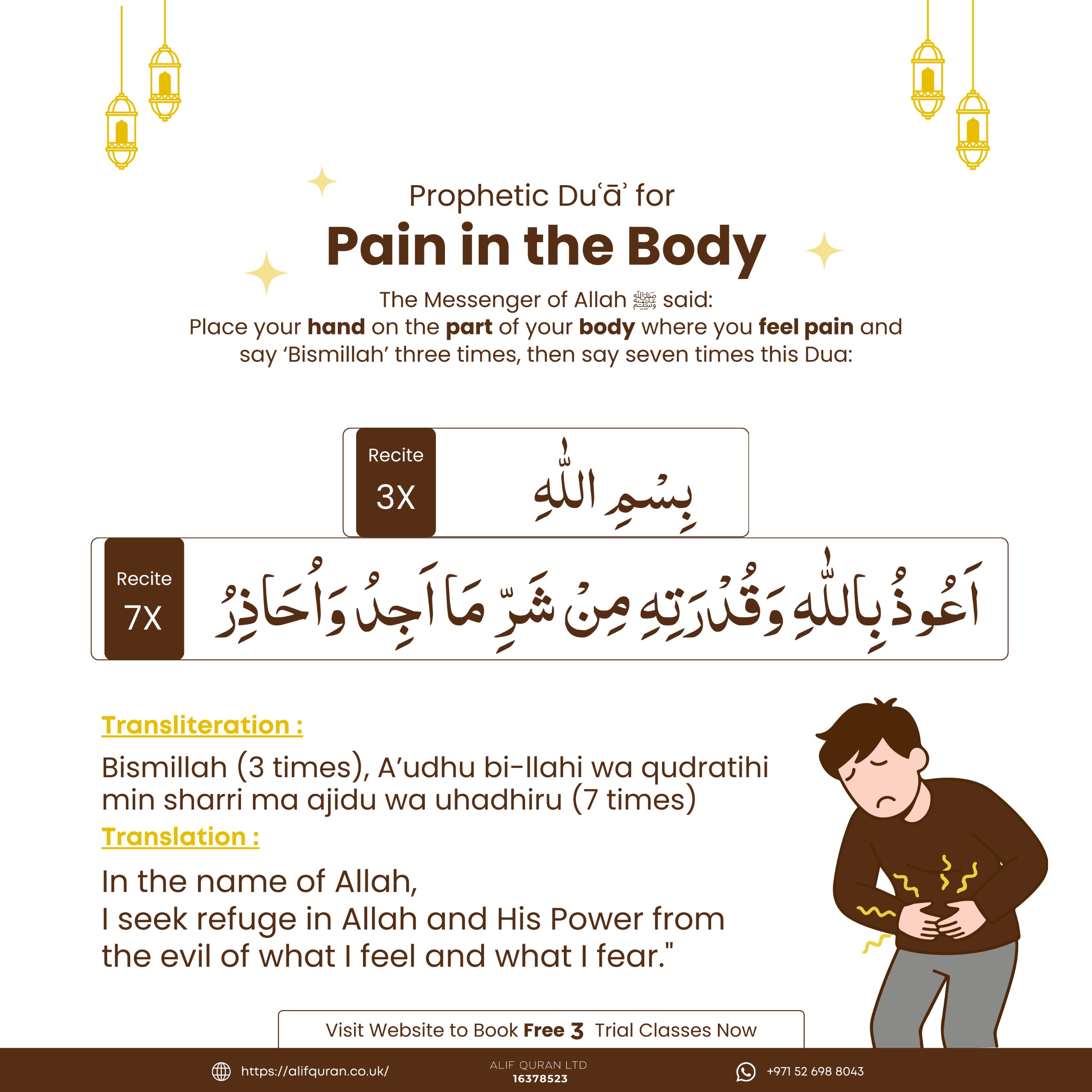
The authentic Dua for pain involves placing your hand on the painful area, saying "Bismillah" 3 times, and then reciting "A’udhu bi-llahi wa qudratihi min sharri ma ajidu wa uhadhiru" 7 times. This method combines physical touch with spiritual reliance on Allah's power.
Physical pain—whether it is a splitting headache, a stomach ache, or chronic discomfort—can be a heavy burden. It affects our worship (Salah), our patience (Sabr), and our daily lives. While modern medicine treats the symptoms, Islam offers a holistic cure that connects the body to the Soul.
The Messenger of Allah (PBUH) taught us a specific Dua for pain that acts as a spiritual antibiotic. This guide will walk you through the correct method, pronunciation, and the deep meaning behind this powerful supplication.
This remedy is not just a cultural practice; it is firmly rooted in the Sunnah. It was narrated by Uthman bin Abu Al-As (RA), who complained to the Prophet (PBUH) about a pain he had felt in his body since he became Muslim.
The Prophet (PBUH) said to him:
"Place your hand on the part of your body where you feel pain and say 'Bismillah' (in the name of Allah) three times, then say seven times: 'I seek refuge in Allah and His Power from the evil of what I feel and what I fear.'"
بِسْمِ اللَّهِ
Bismillah (In the Name of Allah)
أَعُوذُ بِاللهِ وَقُدْرَتِهِ مِنْ شَرِّ مَا أَجِدُ وَأُحَاذِرُ
Transliteration:
A’udhu bi-llahi wa qudratihi min sharri ma ajidu wa uhadhiru
Translation:
"I seek refuge in Allah and His Power from the evil of what I feel and what I fear."
To optimize the effectiveness of this Dua for pain, you must follow the Prophetic method precisely. It is not enough to just say the words; your actions matter.
Yes, absolutely. If a child is too young to recite it, you (the parent) can place your hand on their pain and recite the Dua on their behalf. This is a beautiful way to bond and seek Allah's protection for them.
No, Wudu is not mandatory for making Dua, though being in a state of purity is always encouraged and increases the blessings of the act.
Healing can be instant or gradual. If pain persists, continue the Dua with patience and also seek medical advice. Islam teaches us to trust in Allah (Tawakkul) while also tying our camel (seeking medicine).
Learning Duas is just the beginning. Give your child the gift of the Holy Quran with our expert tutors.
Book 3 Free Trial Classes