01
Surah Al-Fatiha
The Opening · 7 versesBegin here for SalahLearning focus
Al-Fatiha is recited in every rak‘ah of Salah. Learn it slowly with careful pronunciation and an understood meaning before treating it as “already known”.
Prayer foundation



A practical Quran memorisation guide
Short Surahs to memorize can help children, adults and new learners build confidence in Quran recitation and use a wider selection in daily Salah. This guide gives you a sensible starting order, accurate learning priorities and a review routine that protects earlier memorisation.
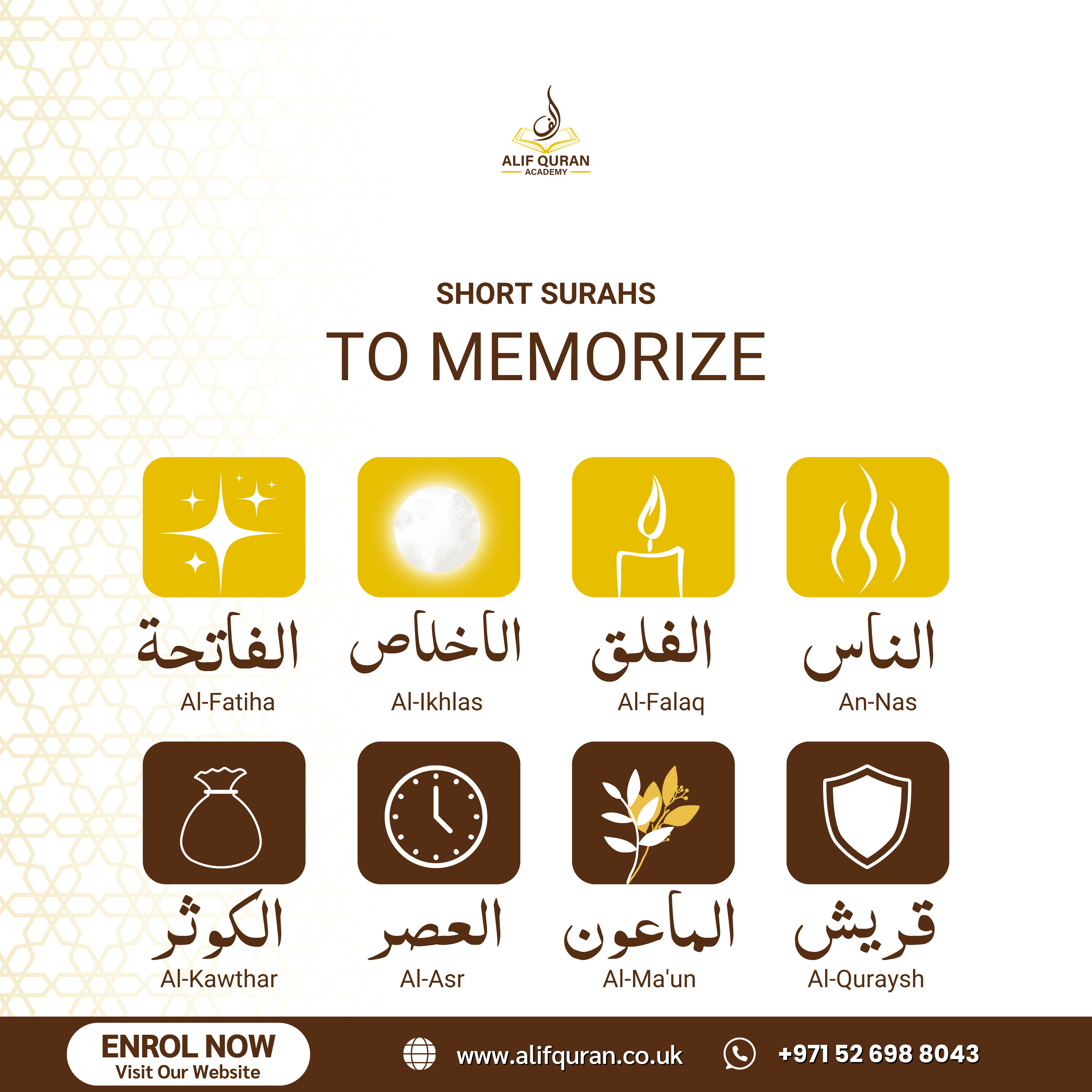
Good short Surahs for beginners include Al-Kawthar, Al-Ikhlas, Al-Asr, Al-Falaq, An-Nas and Al-Kafirun. Al-Fatiha should receive special attention because it is recited in Salah. Learn one Surah at a time, listen to an accurate model, understand the basic meaning and keep older Surahs in weekly review.
Choose by readiness
Verse count matters, but it is only one part of difficulty. A three-verse Surah may contain longer words or unfamiliar sounds. A six-verse Surah may become easy because its pattern repeats.
Before memorising, ask the learner to read or repeat one ayah. If most effort is spent guessing letters, return to Qaida or guided reading first. Memorisation should strengthen accurate recitation, not hide a weak reading foundation.
A useful first collection
The order below balances prayer importance, length, repeated patterns and reading challenge. A teacher may change it according to the learner’s current recitation.
Al-Fatiha is recited in every rak‘ah of Salah. Learn it slowly with careful pronunciation and an understood meaning before treating it as “already known”.
Its four short verses teach the oneness of Allah. Sahih al-Bukhari records its special virtue as being equal to one-third of the Quran in reward.
The shortest Surah is useful for a new memoriser, but words such as al-kawthar still need a teacher’s model so speed does not replace accuracy.
A compact Surah about faith, good deeds, truth and patience. Its clear sequence makes it useful for discussing meaning after the Arabic is secure.
This Surah seeks refuge with Allah from created harms. Practise the opening sounds and final word endings carefully instead of memorising only by rhythm.
Repeated endings make the Surah memorable, but beginners can mix the verse order. Use a meaning cue for each line and review Al-Falaq with it.
The repeated phrases need calm, ordered practice. Use the dedicated Al-Kafirun guide for Arabic, transliteration, meaning and a six-step learning approach.
Only three verses, but the words are longer than in Al-Kawthar. Divide each ayah into meaningful phrases and join them after pronunciation is stable.
The Surah links security, travel, provision and worship. It offers useful practice in reading connected words without turning every phrase into a guess.
A suitable progression after the shorter selections. Its message connects worship with care for others, while its seven verses test steady retention.
A method that tests real memory
Repeated listening helps, but memorisation becomes dependable only when the learner can recall the ayah after the prompt and model have been removed.
Hear one accurate ayah and follow its words. Avoid learning only from transliteration.
Correct important letter and vowel errors before increasing speed or adding more words.
Combine the phrases, then recite without speaking over the teacher or recording.
Practise the transition so each verse has a clear place in the sequence.
Close the text, change activity briefly and test whether the ayah returns independently.
Delayed recall reveals real retention. Keep the Surah in rotation after it is completed.
For parents and teachers
Young learners usually benefit from a visible goal, one correction at a time and an ending they can achieve.
Say which ayah or phrase is being learned. “Finish these two lines accurately” is clearer than “memorise more Quran”.
Allow a short phrase to finish, then model the most important correction. Constant interruption can break confidence and meaning.
Ask for one simple idea from each ayah. Meaning helps separate repeated lines and makes recitation more thoughtful.
Praise accurate independent recitation, patient correction and consistent review rather than only finishing a new Surah quickly.
Practical answers
Use these answers to plan home practice without turning every session into a test.
Begin with a Surah the learner can read accurately. Al-Kawthar is the shortest, while Al-Ikhlas is also brief. Al-Fatiha needs special attention because it is central to Salah. A teacher can confirm whether Qaida revision is needed first.
Usually one active new Surah is enough. Keep older Surahs in a separate review cycle so the child is not learning several similar passages at the same time.
Transliteration can provide temporary support, but it does not show every Arabic sound accurately. Keep the Arabic text visible and use teacher or reciter modelling so transliteration does not become permanent dependence.
There is no single correct number. Repeat until the learner can recite accurately without immediate prompting, then return after a gap to test memory. Ten rushed repetitions are less useful than a smaller number of attentive ones.
A useful test is whether the learner can recite it accurately on a later day, keep the verses in order, recover after a pause and use it in Salah without constant prompting.
Correct one important point at a time: missing words, verse order, an incorrect letter sound or a major vowel error. Too many interruptions can make a young learner anxious and unable to finish the line.
Yes. In a live lesson, the learner can hear a model, recite back, receive correction and follow a review plan. The quality of listening and correction matters more than the physical location.
Use a simple rotation: new learning, recent review and older review. Recite older Surahs in Salah and revisit them on fixed days instead of waiting until they are forgotten.
Use three free trial classes to check reading level, pronunciation and a realistic memorisation routine before choosing regular lessons.