
Free reading material for ages 5-13
Hadith About Eating Manners10 essential Sunnah teachings for children
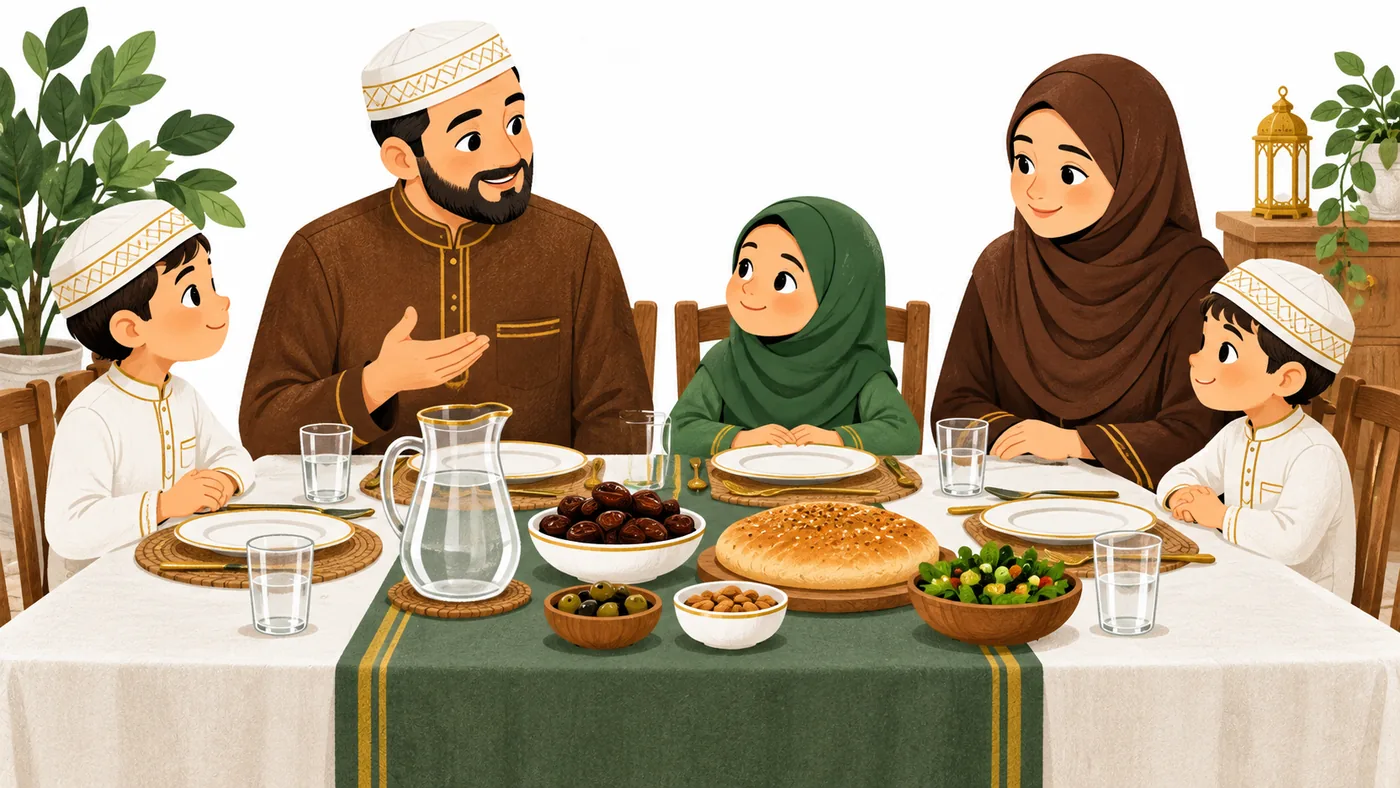
Hadith About Eating Manners help children treat food as a blessing from Allah and eat with remembrance, gratitude and consideration. These ten narrations can be read in order or used one at a time during family meals and Islamic studies classes.
Words to know
Hadith About Eating Manners vocabulary
This vocabulary helps children understand Hadith About Eating Manners before reading the narrations.
Ten sourced narrations
Hadith About Eating Manners: ten teachings to read
The English lines are short meaning summaries for children. Open each source to read the complete narration and context.
Begin in Allah's name
يَا غُلاَمُ سَمِّ اللَّهَ
The Prophet told a young boy to mention Allah's name before eating.
Read complete source: Sahih al-Bukhari 5376What this teaches us
Saying Bismillah reminds children that food is a gift, not something to take for granted. A calm reminder is better than embarrassing someone who forgets.
Talk about it: Why do Muslims remember Allah before an ordinary action like eating?
Use the right hand
وَكُلْ بِيَمِينِكَ
The Prophet taught eating with the right hand.
Read complete source: Sahih al-Bukhari 5376What this teaches us
Children who are physically able can practise this Sunnah patiently. A person with an injury, disability or genuine difficulty should be treated with understanding, never shame.
Talk about it: How can we remind a younger child kindly?
Eat from what is nearest
وَكُلْ مِمَّا يَلِيكَ
When sharing a dish, eat from the part nearest to you.
Read complete source: Sahih al-Bukhari 5376What this teaches us
This simple rule prevents reaching across others and teaches self-control. It also shows how the Prophet corrected a child clearly and gently.
Talk about it: What other table actions show respect for people sharing food?
Do not criticise food
مَا عَابَ النَّبِيُّ طَعَامًا قَطُّ
The Prophet never criticised food; he ate what he liked and left what he did not.
Read complete source: Sahih al-Bukhari 5409What this teaches us
A child may dislike a food without insulting it or hurting the cook. Polite words and a quiet refusal are better than dramatic complaints.
Talk about it: What could you say politely when you do not like a meal?
Pick up a fallen morsel safely
فَلْيُمِطْ مَا كَانَ بِهَا مِنْ أَذًى
A fallen morsel should be cleaned of harm and not wasted when it is safe to eat.
Read complete source: Sahih Muslim 2033What this teaches us
The lesson is respect for food and avoidance of careless waste. Adults must still use sound hygiene judgement; unsafe or contaminated food should not be eaten.
Talk about it: How can we reduce food waste safely at home?
Eat with moderation
فَثُلُثٌ لِطَعَامِهِ وَثُلُثٌ لِشَرَابِهِ
The Prophet taught leaving room rather than filling the stomach excessively.
Read complete source: Jami at-Tirmidhi 2380 - SahihWhat this teaches us
Children need enough nourishing food to grow, but they can learn to notice fullness, take sensible portions and avoid eating only from boredom.
Talk about it: Why is starting with a smaller portion often wise?
Share and make room for others
طَعَامُ الاِثْنَيْنِ كَافِي الثَّلاَثَةِ
Food prepared for two may be sufficient for three, and food for three may suffice four.
Read complete source: Sahih al-Bukhari 5392What this teaches us
The Hadith encourages generosity and sharing. It does not ask children to ignore genuine hunger; it teaches families to welcome others and divide what they have thoughtfully.
Talk about it: How can you make a guest feel welcome at the table?
Value every part of the meal
فَإِنَّهُ لاَ يَدْرِي فِي أَىِّ طَعَامِهِ الْبَرَكَةُ
A person does not know in which part of the food the blessing lies.
Read complete source: Sahih Muslim 2033What this teaches us
The Sunnah teaches respect for the meal rather than careless waste. Children can finish sensible portions and handle food neatly.
Talk about it: What habits cause food to be wasted without need?
Praise Allah after eating
فَيَحْمَدَهُ عَلَيْهَا
Allah is pleased with a servant who praises Him after eating or drinking.
Read complete source: Sahih Muslim 2734aWhat this teaches us
Alhamdulillah turns satisfaction into gratitude. Children can remember the farmer, cook, family and many blessings Allah used to bring food to the table.
Talk about it: Name three people whose work may be behind one meal.
Use the after-meal remembrance
الْحَمْدُ لِلَّهِ الَّذِي كَفَانَا وَأَرْوَانَا
The Prophet used words of praise to Allah after food and drink.
Read complete source: Sahih al-Bukhari 5459What this teaches us
Longer duas can be learned gradually with correct pronunciation. The first goal is to finish with sincere gratitude rather than rushing away from the table.
Talk about it: How can a family help everyone remember the ending dua?
Use the material
Hadith About Eating Manners activities
For a teacher or parent
- Let the child choose one Hadith that stood out.
- Ask the discussion question without suggesting an answer first.
- Create one realistic home or school example together.
- Return to the same Hadith later and ask what the child remembers.
For the learner
- Write the number and title of your chosen Hadith.
- Explain its meaning in your own words.
- Draw or describe a situation where it can be followed.
- Choose one action to practise during the coming week.
Teaching note: Do not present the short English summaries as complete word-for-word translations. Use the linked source for the full narration, and have Arabic wording and religious explanations reviewed by a suitably qualified scholar before publication.
Interactive knowledge check
Hadith About Eating Manners knowledge test
Choose one answer for each question. Your score and feedback will appear at the end.
Question 1 of 10
Which teaching matches Hadith 1: “Begin in Allah's name”?
Question 2 of 10
Which teaching matches Hadith 2: “Use the right hand”?
Question 3 of 10
Which teaching matches Hadith 3: “Eat from what is nearest”?
Question 4 of 10
Which teaching matches Hadith 4: “Do not criticise food”?
Question 5 of 10
Which teaching matches Hadith 5: “Pick up a fallen morsel safely”?
Question 6 of 10
Which teaching matches Hadith 6: “Eat with moderation”?
Question 7 of 10
Which teaching matches Hadith 7: “Share and make room for others”?
Question 8 of 10
Which teaching matches Hadith 8: “Value every part of the meal”?
Question 9 of 10
Which teaching matches Hadith 9: “Praise Allah after eating”?
Question 10 of 10
Which teaching matches Hadith 10: “Use the after-meal remembrance”?
0/10
Continue reading
More Hadith About Eating Manners resources
Use these links to extend Hadith About Eating Manners through related reading and complete source references.
Hadith About Eating Manners source list
1. Sahih al-Bukhari 5376 - Begin in Allah's name2. Sahih al-Bukhari 5376 - Use the right hand3. Sahih al-Bukhari 5376 - Eat from what is nearest4. Sahih al-Bukhari 5409 - Do not criticise food5. Sahih Muslim 2033 - Pick up a fallen morsel safely6. Jami at-Tirmidhi 2380 - Sahih - Eat with moderation7. Sahih al-Bukhari 5392 - Share and make room for others8. Sahih Muslim 2033 - Value every part of the meal9. Sahih Muslim 2734a - Praise Allah after eating10. Sahih al-Bukhari 5459 - Use the after-meal remembrance