

Surah Yunus
يُونُسSurah Yunus calls people to recognise revelation, reflect on Allah’s signs and respond before regret. Prophet Yunus is mentioned near the end as the example of a people whose timely belief benefited them.

A Quran study guide for families and students
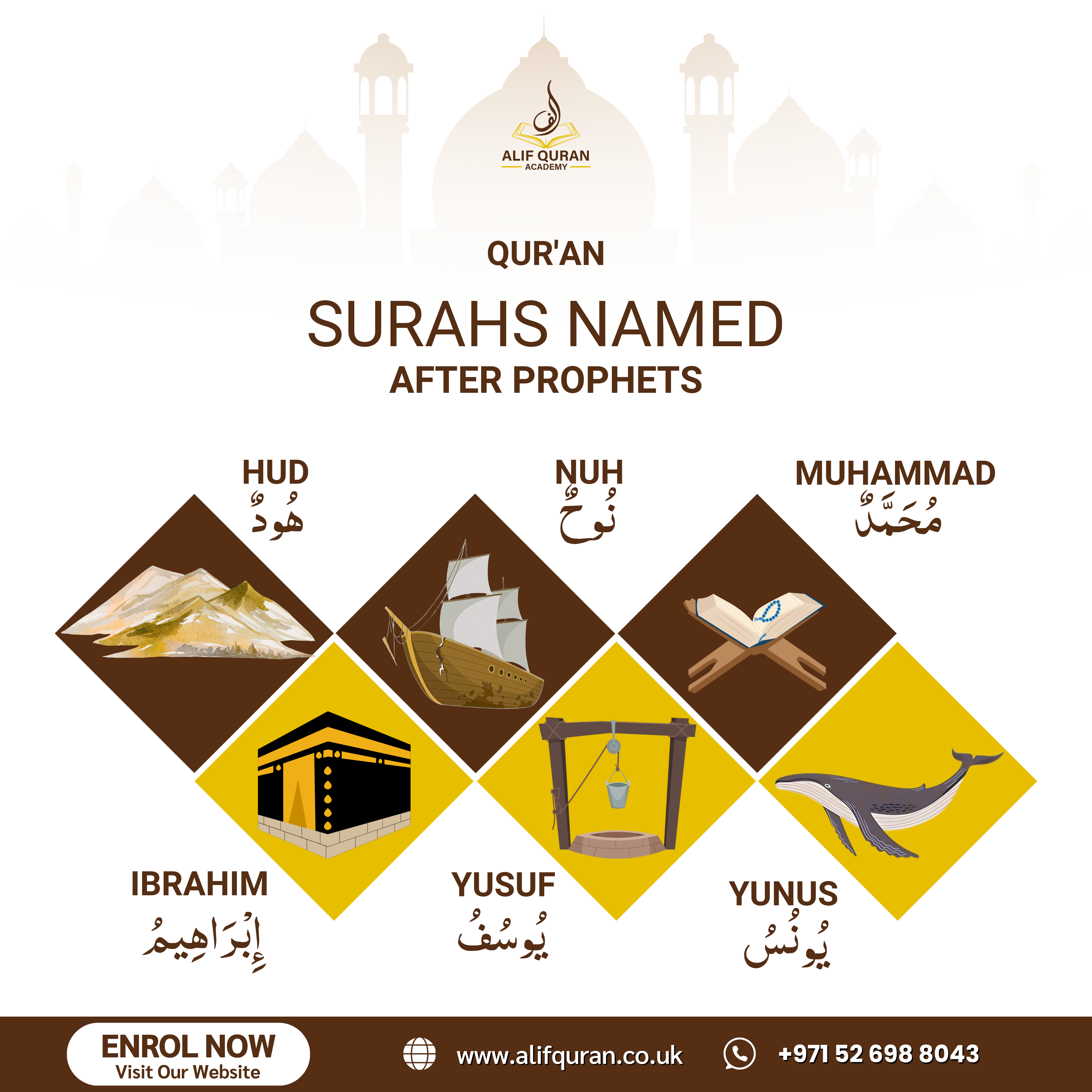
Surahs Named After Prophets link six Quran chapters with Yunus, Hud, Yusuf, Ibrahim, Muhammad and Nuh. Their titles help us identify the chapters, but each Surah must still be studied for its complete message rather than treated as a short biography.
The six Quran Surahs named after individual prophets are Surah Yunus (10), Surah Hud (11), Surah Yusuf (12), Surah Ibrahim (14), Surah Muhammad (47) and Surah Nuh (71). Surah Al-Anbiya means “The Prophets”, but it is a collective title and is not named after one individual prophet.
Read titles carefully
Quran chapter names help identify a Surah. Sometimes the title reflects a major narrative, as in Surah Yusuf. In other cases, the named prophet appears within a chapter whose teachings cover many subjects.
This distinction prevents a common mistake: assuming Surah Yunus is mainly a full biography of Yunus, or that Surah Hud discusses only Hud. Read the surrounding ayahs and the chapter’s wider argument.
Useful exception: Surah Al-Anbiya is translated as “The Prophets”. It mentions several prophets but is not named after one particular prophet, so it is normally discussed separately from these six.
Note the Surah number, Arabic name and number of ayahs.
Observe where and how the prophet appears in the chapter.
Record the themes before and after the prophet’s account.
Study an authentic supplication with its verse and context.
Quran-order chapter atlas
Move through the Surahs in Quran order. Each entry separates the chapter’s wider theme from a practical lesson and links to a related Prophetic Dua lesson.
Surah Yunus calls people to recognise revelation, reflect on Allah’s signs and respond before regret. Prophet Yunus is mentioned near the end as the example of a people whose timely belief benefited them.
Surah Hud presents accounts of several messengers, including Nuh, Hud, Salih, Ibrahim, Lut, Shu‘ayb and Musa. Its title comes from Prophet Hud, but its message is wider than one biography.
Surah Yusuf gives a sustained account of Prophet Yusuf: his dream, separation from his family, temptation, imprisonment, responsibility in Egypt and reunion. The narrative repeatedly shows Allah’s wisdom unfolding through hardship.
Surah Ibrahim contrasts gratitude with ingratitude, truth with falsehood and lasting revelation with unstable claims. It includes Prophet Ibrahim’s prayers for Makkah, worship and his descendants.
Surah Muhammad addresses belief, obedience, moral seriousness and the responsibilities of the early Muslim community during conflict. Its guidance must be read in its Quranic and historical context, not reduced to slogans.
Surah Nuh records the prophet’s patient call to his people by night and day, publicly and privately. It shows the clarity of his message, the resistance he faced and his complete turning to Allah.
Continue with Quranic supplications
The Surah titles introduce six prophets. Their Quranic duas add another layer: repentance, guidance, prayer, reliance and hope. Use the individual lessons below, or open the complete collection.
For parents, teachers and students
Do not try to teach every historical detail at once. Use a repeated structure so the learner knows what to look for and can explain the chapter in their own words.
Notice the chapter’s central call, warning, comfort or conclusion.
Mark what the Quran says directly and avoid adding unsupported story details.
Use themes grounded in the ayahs, not a motivational message imposed on the text.
Read its Arabic, meaning, speaker and situation using the linked Dua lesson.
Explain how the guidance can shape worship, patience, gratitude or character today.
Clear answers
These answers correct common misunderstandings and help families teach the topic accurately.
Six Surahs bear the names of individual prophets: Yunus, Hud, Yusuf, Ibrahim, Muhammad and Nuh. Surah Al-Anbiya means “The Prophets”, but it is a collective title rather than the name of one prophet.
No. Surah Yusuf is strongly centred on Yusuf’s story and Surah Nuh closely presents Nuh’s call, but Yunus, Hud, Ibrahim and Muhammad cover broader teachings and events. A title identifies a chapter; it does not necessarily summarise every passage.
Surah Yusuf presents a connected narrative of Prophet Yusuf across most of the chapter. Other prophetic accounts in the Quran are often distributed across several Surahs.
Surah Al-Ankabut 29:14 states that Nuh remained among his people for a thousand years minus fifty. It is safer to use the Quran’s wording than to add details the verse itself does not specify.
The Quran should be recited for worship, guidance and reflection. Do not promise a specific worldly result for a particular Surah unless reliable evidence establishes it. Readers can study the chapter’s authentic meanings and make Quranic duas with sincerity.
Its title means “The Prophets” and the chapter mentions several prophets. It is not counted among the six Surahs named after one individual prophet.
Quran order is a clear option: Yunus, Hud, Yusuf, Ibrahim, Muhammad and Nuh. A younger learner may begin with Nuh because it is shorter, or Yusuf because its connected story is easier to follow.
Alif Quran Academy’s Powerful Duas of Prophets resource links to individual lessons for Yunus, Nuh, Yusuf, Ibrahim, Muhammad and other prophets, with context and simple learning points.
Use three free trial classes to explore Quran reading, Tajweed, memorisation or Islamic Studies with a suitable teacher.